The name is a small map.
A lock on one bank, a lane on the other, and the bridge between.
Some places have to be explained. The two river towns of New Hope, Pennsylvania and Lambertville, New Jersey are not among them — stand on the bridge between them on a bright morning, with the Delaware moving slow beneath you and clapboard rooftops stacked up both green banks, and the place makes its own argument.
The name, though, is worth a few minutes. Lock & Lambert is not a founder's surname or an invented word. It is, almost literally, a description of where you'll be staying: a lock on the Pennsylvania side, a lane in a town called Lambertville on the New Jersey side, and the bridge that has tied the two together for more than a century.
Lock
In the spring of 1827, crews began to dig. What they were digging was a canal — nearly sixty miles of it, by hand, along the Pennsylvania bank of the Delaware. Five years later the Delaware Canal opened: a long ribbon of still, shallow water running from Bristol in the south up to Easton in the north, laid down to carry anthracite coal out of the mountains toward Philadelphia. Mule teams walked a path beside the water — the towpath — and hauled the loaded boats along at the pace of a slow walk.
A canal, unlike a river, cannot simply run downhill. Over its length the Delaware Canal has to fall a hundred and sixty-five feet, and to manage that drop without losing its water, its builders set twenty-three locks into it. A lock is best thought of as an elevator for boats: a short walled chamber with a heavy wooden gate at each end. A boat floats in, the gates close behind it, water is let in or drained away until the level inside matches the canal ahead, and the far gate swings open — and the boat goes on, a few feet higher or lower than it was. In the working years a lock-tender lived right beside his lock, in a small house built for the purpose, a lockhouse, so that he could rise and work the gates at whatever hour a mule team's lantern came around the bend.
Most of America's towpath canals are gone now — filled in, paved over, or left to the weeds. The Delaware Canal is the one that survived. It is the only towpath canal of its era still intact along its entire length: watered, walkable, and today a state park you can follow for nearly sixty unbroken miles.
In New Hope, the canal runs straight through town. Behind 137 South Main Street — the building with our Main St Hideaway on the upper floor — the canal still holds water, and a lock and its small weathered lockhouse, grey with age, still stand at the back door. That lock is the Lock in Lock & Lambert. You can watch it from the patio.
Lambert
Cross the bridge — five minutes on foot — and you are in Lambertville.
It did not begin under that name. Like New Hope facing it across the water, Lambertville started as a ferry landing; for most of the eighteenth century the crossing here was Coryell's Ferry, after the family who ran the boats and kept an inn for travelers breaking the journey between Philadelphia and New York. The town took its present name in 1810, the year a post office opened on the New Jersey bank — an office secured through the efforts of John Lambert, a farmer's son from the Amwell country nearby who had risen to become a state legislator, acting Governor of New Jersey, and, from 1809, a United States Senator. The grateful settlement took his name, and has kept it for more than two centuries.
Today Lambertville is a town of antique shops and galleries, of old stone and clapboard houses, with a riverfront that has drawn people up from Philadelphia and down from New York for generations. Lambert Lane — the quiet street our house sits on, with the Delaware just past the back fence — still carries the Senator's name. That lane, and that town, are the Lambert in Lock & Lambert.
&
Which leaves the ampersand.
The & is the bridge.
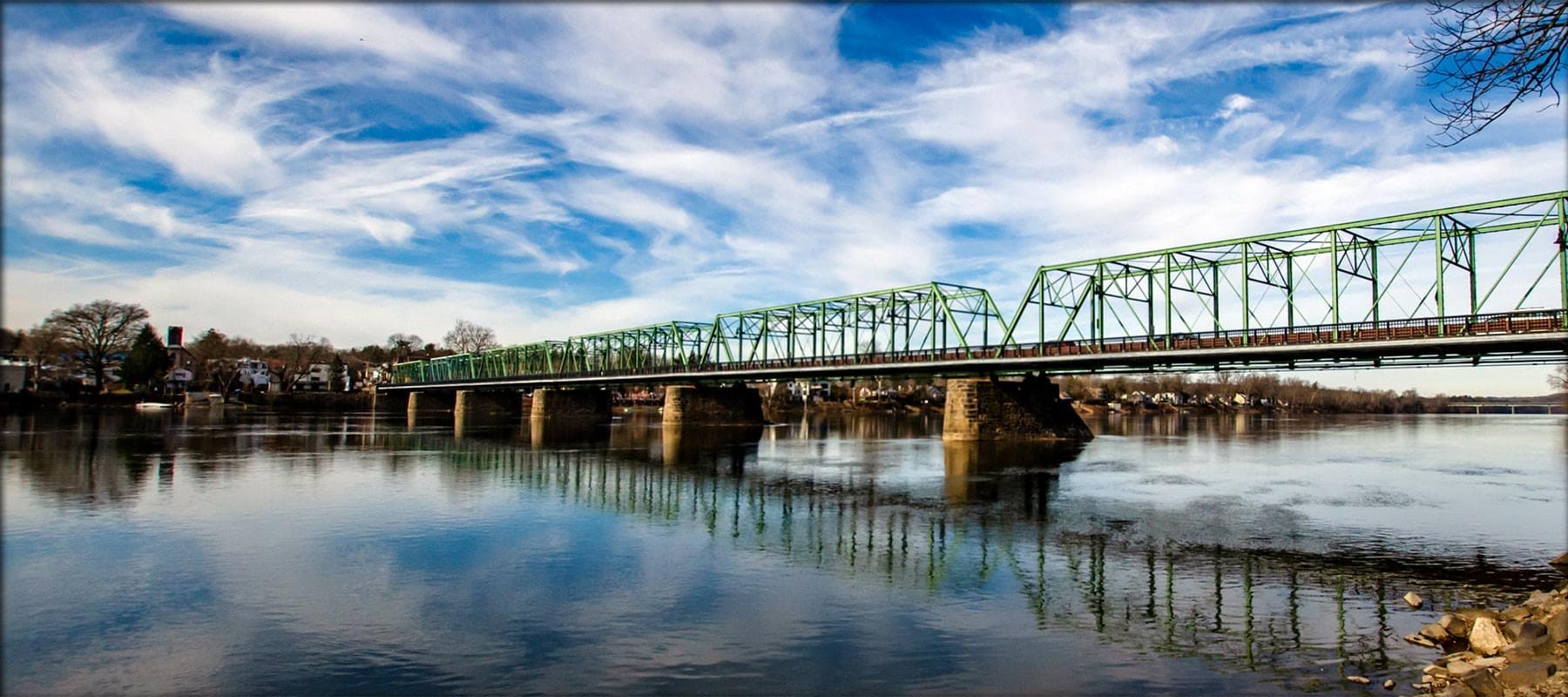
There has been a crossing here for a very long time. The first true bridge — a covered wooden one, more than a thousand feet long — was raised in 1814, the work of Lewis Wernwag, a bridge-builder known up and down the region. A flood damaged it in 1841; the covered bridge that replaced it was swept away entirely by the great flood of 1903. The bridge you walk or drive across today is the one that followed: a six-span steel truss, opened in the summer of 1904, and free of tolls since 1919. It is painted a soft green that has, over the decades, become one of the most familiar sights on this stretch of the river.
It is also the reason a stay here is never quite a stay in one town. The bridge makes New Hope and Lambertville a single place — two banks, one walkable trip, joined by a five-minute walk over moving water. That is the work the ampersand does in the name. Lock & Lambert: the and is the bridge between.
So there it is, unfolded — a lock on one bank, a lane in Lambertville on the other, and the bridge in the middle. Three places to stay, two towns, one river, and a name that, once you know it, tells you exactly where you are going.
Sources
The history on this page is drawn from public records and reputable local sources: the Friends of the Delaware Canal and the Pennsylvania Department of Conservation and Natural Resources, for the canal's construction, its locks, and the towpath; the Lambertville Historical Society and the U.S. House of Representatives history archive, for the town's naming and for Senator John Lambert; and the Delaware River Joint Toll Bridge Commission, for the bridge and its 1814, 1904, and 1919 milestones. Dates and figures were verified in May 2026.
Coming back? We'll tell you first.
An email when something opens up, and another when the season turns. Nothing else.
No spam. Unsubscribe any time.